
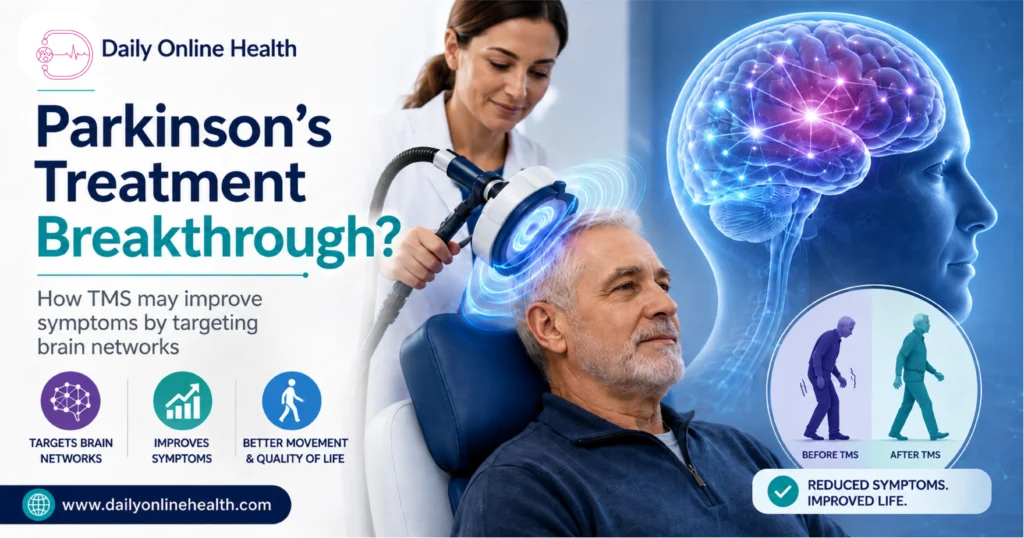
What is the new treatment breakthrough in Parkinson’s disease?
For decades, Parkinson’s disease treatment has mainly focused on replacing dopamine or stimulating specific deep brain regions affected by the disease. Although treatments such as levodopa medication and deep brain stimulation (DBS) can significantly improve symptoms, they do not stop disease progression and do not work equally well for every patient.
A recent study published1 in Nature introduces a different way of understanding Parkinson’s disease and identifies a potential new treatment target: a brain network called the somato-cognitive action network (SCAN). The study suggests that correcting abnormal activity in this network may offer a new pathway to improve Parkinson’s symptoms, particularly through non-invasive brain stimulation such as transcranial magnetic stimulation (TMS).
Why could this discovery change Parkinson’s treatment?
Parkinson’s disease is usually described as a movement disorder caused by damage to dopamine-producing neurons. However, many symptoms patients experience—such as problems with walking, motivation, body awareness, sleep, and cognitive function—cannot be explained by a single damaged brain area.
The researchers found that Parkinson’s disease involves abnormal communication across a larger brain network. Instead of treating only one damaged region, future treatments may aim to “reset” the dysfunctional network responsible for multiple symptoms. This represents a shift from region-based treatment toward network-based treatment.
What role does TMS play in this new approach?
Transcranial magnetic stimulation (TMS) is a non-invasive treatment that uses magnetic pulses to influence activity in specific brain regions. Unlike DBS, which requires surgical implantation of electrodes, TMS can be performed externally without brain surgery.
In this study, researchers tested whether targeting the SCAN could improve Parkinson’s symptoms. They found that:
- TMS targeting SCAN-related regions produced greater symptom improvement than stimulation of traditional motor areas.
- The treatment appeared to reduce abnormal brain connectivity associated with Parkinson’s disease.
- The improvement was linked to changes in the same brain network identified as abnormal in Parkinson’s disease.
These findings suggest that TMS may not simply stimulate movement areas but may help normalize the broader brain network involved in Parkinson’s symptoms.
How was the treatment effect studied?
The researchers combined evidence from multiple treatment approaches, including:
- Transcranial magnetic stimulation (TMS)
- Deep brain stimulation (DBS)
- Levodopa medication
- MRI-guided focused ultrasound treatment
Across these approaches, treatments that improved Parkinson’s symptoms were associated with changes in SCAN-related brain activity. This supports the idea that the SCAN may represent a common therapeutic target for Parkinson’s disease.
Does this mean Parkinson’s disease can now be cured?
Not yet.
The study provides an important breakthrough in understanding the brain mechanisms of Parkinson’s disease, but it does not show that Parkinson’s disease can currently be cured or reversed completely. Instead, it offers hope for developing more effective treatments that may:
- Improve motor symptoms more precisely
- Reduce treatment-related limitations
- Provide options for patients who do not respond well to existing therapies
- Allow personalized brain stimulation based on individual brain networks
Future clinical trials are needed to determine whether SCAN-targeted TMS can provide long-term benefits and influence disease progression.
Who could benefit from this new treatment approach?
If further studies confirm these findings, SCAN-guided TMS could become especially valuable for:
- Patients who want a non-surgical treatment option
- Patients with inadequate response to medication
- Patients who are not suitable candidates for DBS surgery
- Individuals who require personalized symptom management
Because TMS is non-invasive, it has the potential to become a more accessible treatment option compared with surgical approaches.
What is the future of Parkinson’s treatment?
The future may not be about replacing dopamine alone—it may be about repairing the communication pathways within the brain.
This study suggests that Parkinson’s disease may be treated by targeting the brain networks that generate symptoms rather than only the damaged cells causing them.
Although a cure remains a future goal, identifying the SCAN as a treatment target represents a major step toward a new generation of personalized therapies. Brain-network-guided TMS could become one of the promising tools that change how Parkinson’s disease is treated in the coming years.
Sources and references
This article is for general education and does not provide a diagnosis or replace advice from an appropriately qualified healthcare professional. For urgent symptoms, contact your local emergency service or go to the nearest emergency department.